NIC MAP AI Skills
Designing a New AI Experience
Overview
Type
In-house Product
Role
Product Designer
Date
2025
Deliverables
High-fidelity Wireframes
Interactive Prototypes
Engineering handoff
Tools
Figma
Team
Product Design Lead, Product Manager, Engineers
Problem
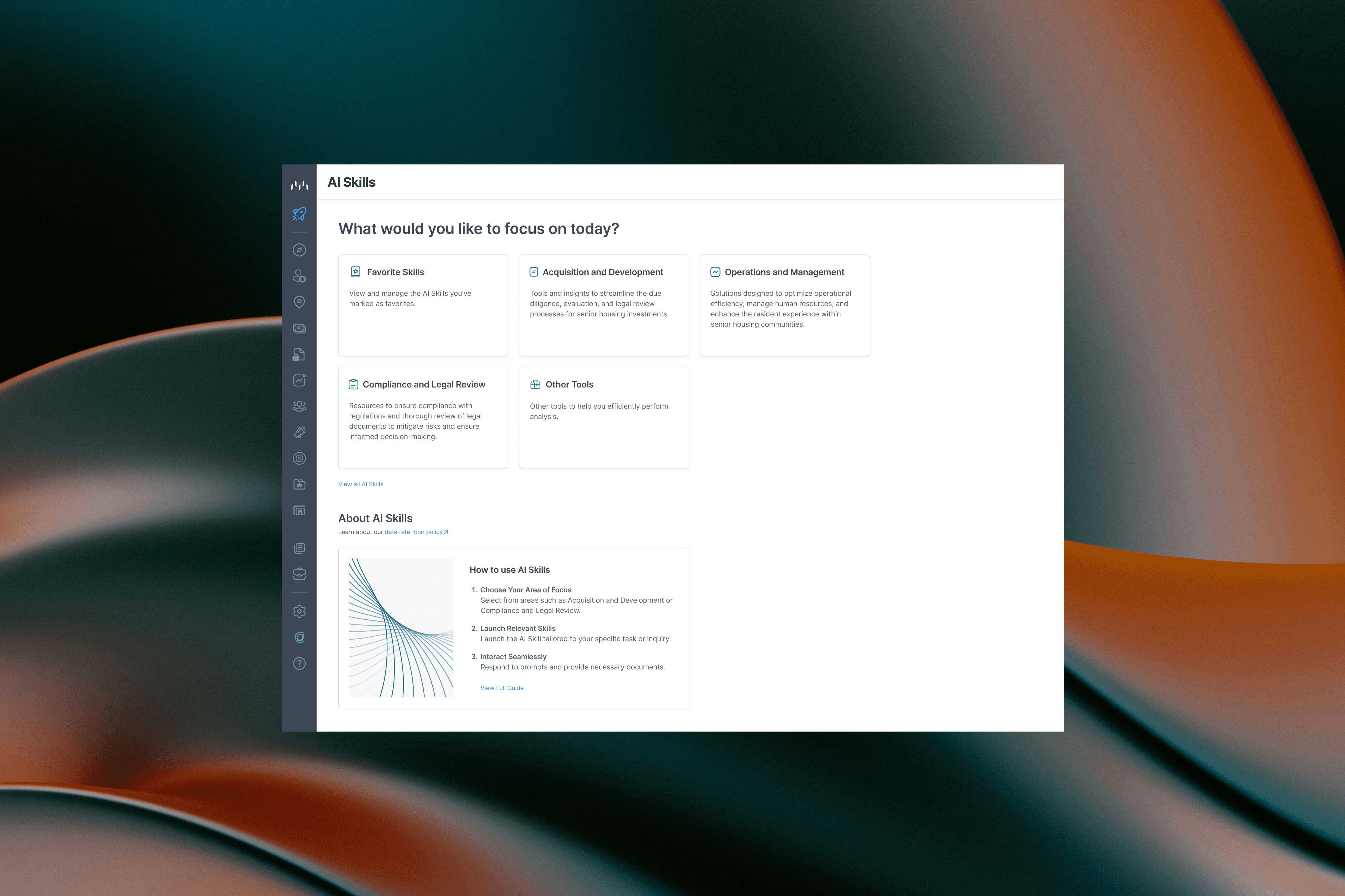
AI Skills can support many types of tasks, but users would first need to understand what they could accomplish, what information they would need to provide, and what they would receive in return. With 50+ capabilities and different types of NIC MAP users, the experience could easily become difficult to navigate and understand.
The goal was to create a clear starting point that would help users find the right tool for their needs, guide them through the required inputs, and make the input → analysis → output flow feel straightforward.
Design Process
I defined how users would navigate and discover AI Skills. Instead of presenting every tool all at once, I organized them into 3–4 categories that represent common workflows for senior housing professionals.
This created a two-level hierarchy:
Level 1 — Categories
High-level work types that help users identify what they want to accomplish.
Level 2 — Skills
Individual AI tools presented within each category.


Designing the AI Skill Experience
Once the user flow had been established, I designed the AI Skill experience around three stages: input → processing → output. This included defining the information and files users needed to provide, how the AI communicated progress while processing, and how the analysis or report was presented as a downloadable PDF.
I also designed the different states needed to support the experience, including loading, empty, and error states.
From there, I created interactive prototypes and refined the experience with the product design lead, product manager, and engineer.


Engineering Handoff
To prepare the final prototype for implementation, I provided design annotations and handoff notes to clarify interactions, states, and edge cases. As implementation progressed, we made a few rounds of iterations based on technical constraints and engineering feedback.
After implementation, I conducted a design QA to review the product against the final designs. I documented remaining issues and opportunities for improvement to carry into Phase 2.
AI Skills successfully shipped as NIC MAP’s first AI-powered tool and provided senior housing professionals a simpler way to complete complex and time-consuming tasks.